
The Interfaith Center for Sustainable Development is committed to partnering with ecologically-focused clergy and theologians to augment the faith voice in hastening the transition to cleaner, healthier and more sustainable communities.
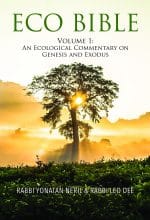
In conjunction with the publication of Eco Bible, Vol. 1: An Ecological Commentary on Genesis and Exodus, we are sponsoring the following two webinars featuring theologians working at the edges of religion and ecology.
“Food, Faith, Ecology: Grounding and Gratitude”
November 19, 2020 at 10am Pacific Time
Just one week before the Thanksgiving holiday, we will be exploring an approach to “Holy Eating” from Jewish, Christian, and Muslim perspectives.
[maxbutton id=”23″]
Shaykh Mustafa Umar, the president of California Islamic University and the Director of Education and Outreach at the Islamic Institute of Orange County. He has authored several books, served the Muslim community of Southern California as an Imam and activist for over a decade, and currently serves as an executive member of the Fiqh council of North America. He completed a B.S. in Information and Computer Science from UC Irvine, a B.A. in Theology & Islamic Law from the European Institute of Islamic Sciences in France, and an M.A. in Islamic Studies from the University of Gloucestershire in the UK. He also studied the Islamic sciences for a year at Nadwatul ʿUlamā’ in Lucknow, India, spent another year studying in Cairo, Egypt, and completed the traditional iftaa program at Darul Ifta, granting him the traditional title of ‘Mufti’, or specialist in Islamic Law.
Rev. Dr. Jill Crainshaw, Vice Dean for Faculty Development and Academic Initiatives at Wake Forest University School of Divinity, where she also serves as the Blackburn Professor of Worship and Liturgical Theology. An ordained Minister of Word and Sacrament in the Presbyterian Church (U.S.A.), Crainshaw is a well-known author in her field of liturgical theology, as well as a poet and preacher. Through her writing and teaching, she celebrates life’s seasons and seasonings. She and her two dogs, Bella and Penny, look for poems each day in their backyard. Sometimes Jill writes them down. Dr. Crainshaw’s most recent book, When I in Awesome Wonder: Liturgy Distilled from Daily Life, focuses on the importance of being grounded in God’s wisdom as we discover it in our daily life, work, and play.
Rabbi Bill Kaplan, Executive Director of the Shalom Institute in Malibu, a year-round experiential Jewish and environmental education center and the home of Shemesh Farms, a social enterprise that employs adults with developmental disabilities. Shalom Institute strives to model eco-friendly practices that include solar power and water heating, composting, organic farming and gardening, recycling, water use reduction, recycled plastic furniture, energy efficiency, and much more. Bill is in his 31st year at Shalom Institute and has a BA from Wesleyan University in Middletown, CT., an MBA in Non-Profit Management and Jewish Communal Service from American Jewish University, and rabbinical ordination from the Academy For Jewish Religion in Los Angeles. He uses nature, organic gardens, and biblical gardens creatively to teach Torah, Israel, Jewish culture, holidays, and connections between Judaism and ecology in a model he calls “Edible Judaism”.
“Climate Realities, Climate Change: Envisioning our Future”
December 10, 2020 at 10am Pacific Time
As we head into the year 2021, we look to our religious traditions for vision and foresight as we confront the challenges facing us as a result of climate change.
[maxbutton id=”24″]
Rabbi Yonatan Neril, ICSD founder and co-author of the Eco Bible, will be joined by:
Dr. Laurie Zoloth, Margaret E. Burton Professor of Religion and Ethics at the University of Chicago Divinity School and the Senior Advisor to the Provost for Programs on Social Ethics. Zoloth holds a bachelor’s degree in women studies from the University of California, Berkeley and a bachelor’s degree in nursing from the University of the State of New York. She received a master’s degree in Jewish studies and a doctorate in social ethics from the Graduate Theological Union. Zoloth also holds a master’s degree in English from San Francisco State University. A leader in the field of religious studies with particular scholarly interest in bioethics and Jewish studies, Zoloth’s research explores religion and ethics, drawing from sources ranging from Biblical and Talmudic texts to postmodern Jewish philosophy. She also researches the practices of interreligious dialogue, exploring how religion plays a role in public discussion and policy.
Dr. Chris Doran, Professor of Religion at Pepperdine University. He studied the intersection of theology and science at Berkeley’s Graduate Theological Union after receiving a bachelor’s degree in biology and a Master of Divinity from Pepperdine, and then returned to his alma mater as faculty. After acknowledging that climate change is the most significant issue facing the future of human civilization, he created the Sustainability Minor, the largest multidisciplinary program in the history of Pepperdine’s Seaver College. His most recent book is Hope in the Age of Climate Change: Creation Care this Side of the Resurrection, which looks to understand how the resurrection of Jesus should inspire us to be leaders in solutions to climate change and other sustainability challenges. His current research project seeks to articulate a Christian theological response to both human and nonhuman migration and displacement due to the climate crisis.
Dr. Mark Douglas, an ordained minister in the Presbyterian Church (USA) and Professor of Christian Ethics at Columbia Theological Seminary in Decatur, GA, where he directs the Master of Theology degree program. He is the founding editor of @ this point: theological reflections on church and culture, the seminary’s online journal, and the author of Confessing Christ in the 21 st Century (Rowman and Littlefield, 2005), Believing Aloud: Reflections on Being Religious in the Public Sphere (Cascade, 2010), Christian Pacifism for the Environmental Age (Cambridge University Press, 2019), and a forthcoming book, Modernity, the Environment, and the Just War Tradition. His current work explores connections between violence and climate change at the beginning of the Anthropocene.